

“Whether you think you can, or you think you can’t—you’re probably right.” – Henry Ford
Every child begins life with an incredible capacity to learn. A baby does not stop trying to walk after falling a few times. A toddler does not give up speaking because the first words are unclear. They keep trying, learning, adjusting, and growing. Somewhere along the way, however, many children begin to fear mistakes, avoid challenges, and believe that success belongs only to those who are “naturally talented.”
This is where the concept of a Growth Mindset becomes transformative.
Psychologist Dr. Carol Dweck introduced the idea that our beliefs about our abilities shape the way we learn. People with a fixed mindset believe intelligence and talent are predetermined—they often avoid challenges because failure feels like proof that they are “not good enough.” In contrast, those with a growth mindset believe that abilities develop through effort, effective strategies, persistence, and learning from mistakes.
The difference may seem small, but it changes everything.
Imagine two students who receive a low score on a mathematics test.
One says, “I’m just not good at Maths.” The other says, “I didn’t understand this topic yet. I need to practise differently.”
Both students faced the same challenge. The difference lies not in their ability but in their mindset. One sees failure as the end of the journey; the other sees it as the beginning of learning.
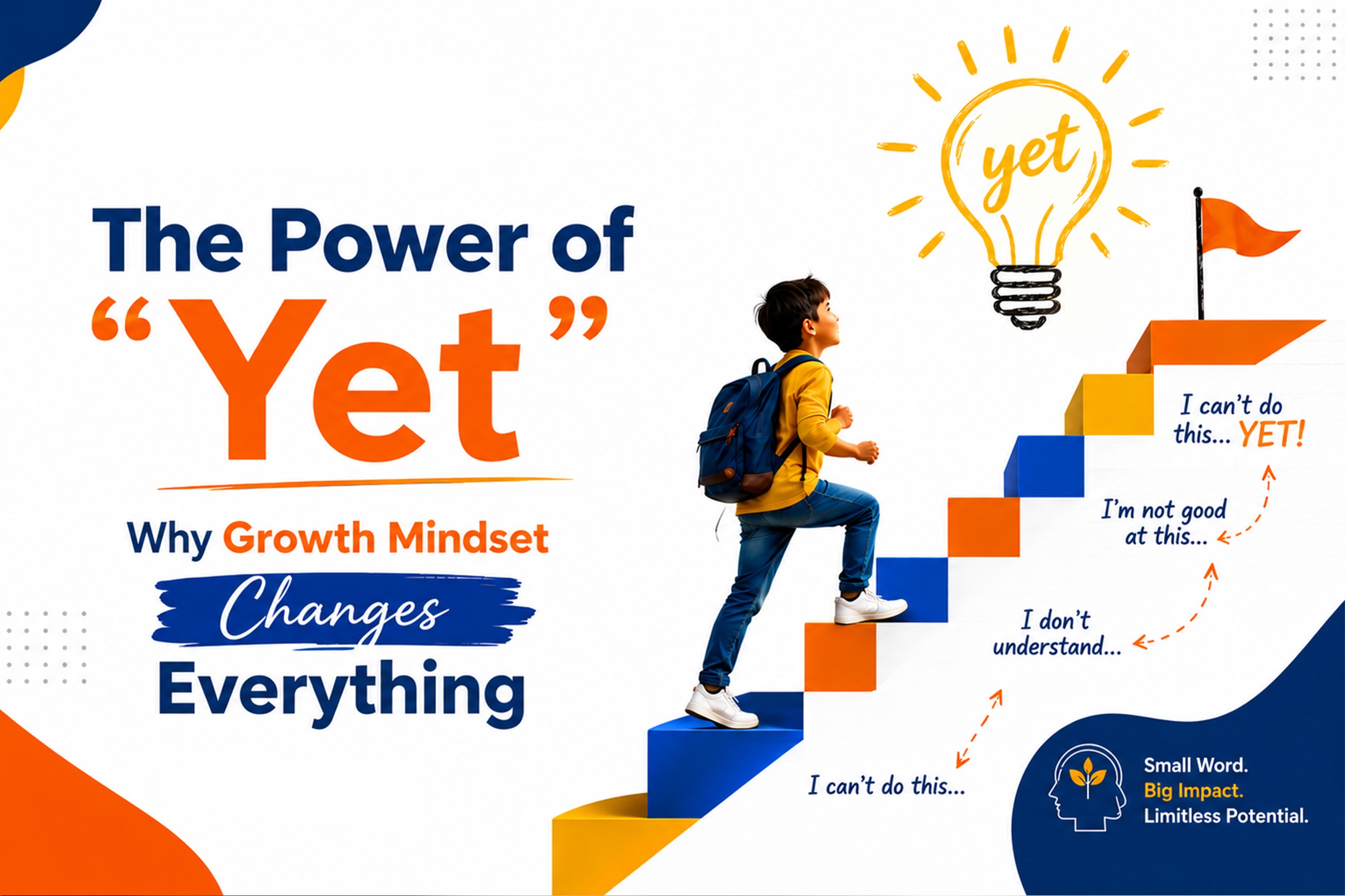
The word “yet” is powerful. It transforms “I can’t” into “I can’t yet.” It replaces limitation with possibility and reminds us that learning is a process, not an event.
Modern neuroscience tells us that the brain is remarkably adaptable. Every time we learn a new skill, solve a problem, or practise something challenging, our brain forms and strengthens new neural connections. This ability, known as neuroplasticity, means that intelligence is not fixed—it grows with meaningful effort and experience.
Every mistake becomes information.
Every challenge becomes practice.
Every attempt makes the brain stronger.
When children understand this, they begin to see effort not as a sign of weakness but as evidence that their brains are growing.
A growth mindset is not developed by children alone. It grows when the adults around them consistently reinforce the same belief.
Students learn to embrace challenges, ask questions without fear, and celebrate progress instead of perfection.
Teachers create classrooms where mistakes are welcomed as part of learning, where curiosity is encouraged, and where feedback guides improvement rather than discouragement.
Parents shape mindset through everyday conversations. Instead of asking only about marks, they ask what their child learned, what challenged them, and what they are proud of trying.
When home and school speak the same language of growth, children develop confidence that lasts far beyond the classroom.
Simple changes in language can have a profound effect.
Instead of saying:
Try saying:
Instead of:
Say:
Instead of:
Think:
These shifts encourage resilience, optimism, and a willingness to keep learning.
Developing a growth mindset does not mean believing everything will be easy. It means believing that every challenge offers an opportunity to improve.
At IRA Universal School, we encourage our learners to ask questions, explore ideas, persevere through challenges, and view mistakes as stepping stones to success. We believe education is not about proving how much a child knows today but about nurturing the confidence and curiosity to keep learning tomorrow.
When students believe they can grow, teachers believe every learner can succeed, and parents celebrate effort alongside achievement, something remarkable happens. Learning becomes joyful, resilience becomes a habit, and success becomes a journey rather than a destination.
As a family, or as a classroom, try replacing the phrase “I can’t” with “I can’t yet.”
Notice how one small word changes not just a sentence, but an entire way of thinking.
Because every great achievement begins with the courage to say…