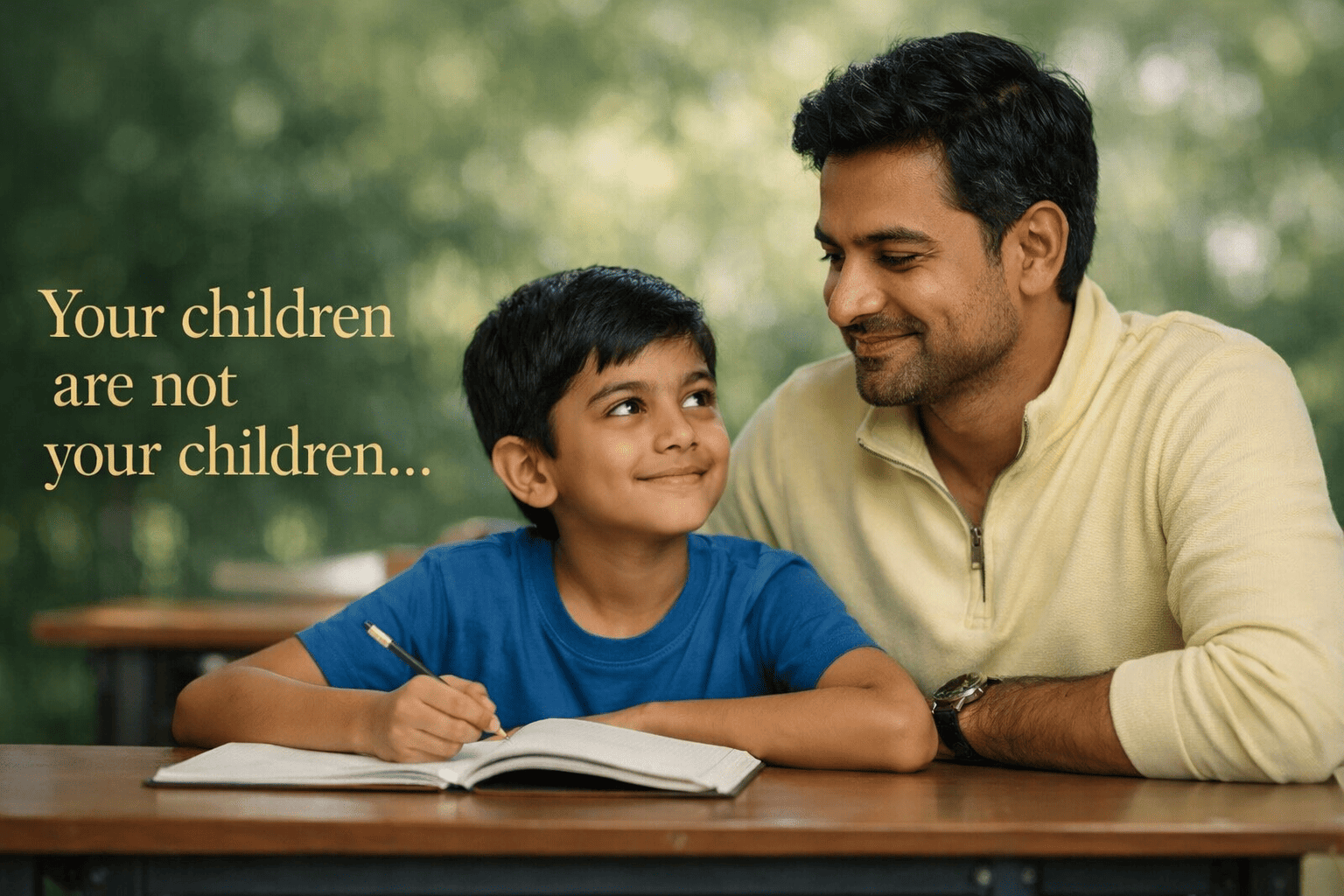
It was a usual afternoon when Aarav’s mother walked into school, concerned and anxious. “Ma’am, he is not scoring well. Please make him focus. He has to do better.”
Later that day, I sat beside Aarav. His notebook was incomplete, but his eyes sparkled when he spoke about building machines. He wasn’t disengaged—he was unseen.
That evening, I revisited Gibran’s words: “They come through you but not from you… and though they are with you, yet they belong not to you.”
And it shifted something deeply.
As teachers and parents, we often carry invisible expectations—marks, behavior, definitions of success. But Gibran gently reminds us:
We are not owners of children’s futures; we are guides of their journeys.
A growth mindset, when seen through Gibran’s lens, becomes more human, more compassionate, and more powerful.
Here’s what this looks like in our classrooms and homes:
See the child beyond performance Every child carries a unique potential. Our role is to discover, not define it.
Guide, don’t control Instead of “Do it this way,” ask, “How would you like to try this?” Ownership builds confidence.
Detach from rigid outcomes Marks matter, but they are not the measure of a child’s worth or capability.
Nurture curiosity over compliance A questioning child is a thinking child—and thinking is the foundation of growth.
Hold space, not pressure Children grow best where they feel safe, seen, and supported—not judged.
The next day, I told Aarav, “Your ideas matter. Let’s use math to build your machines.”
For the first time, fractions made sense—not because they were taught differently, but because he was seen differently.
And his mother? She began to listen—not just to his scores, but to his dreams.
Perhaps growth mindset is not only about believing that abilities can improve.
Perhaps it is about believing that every child is already becoming—in their own time, in their own way.
And we… are simply there to walk beside them.